
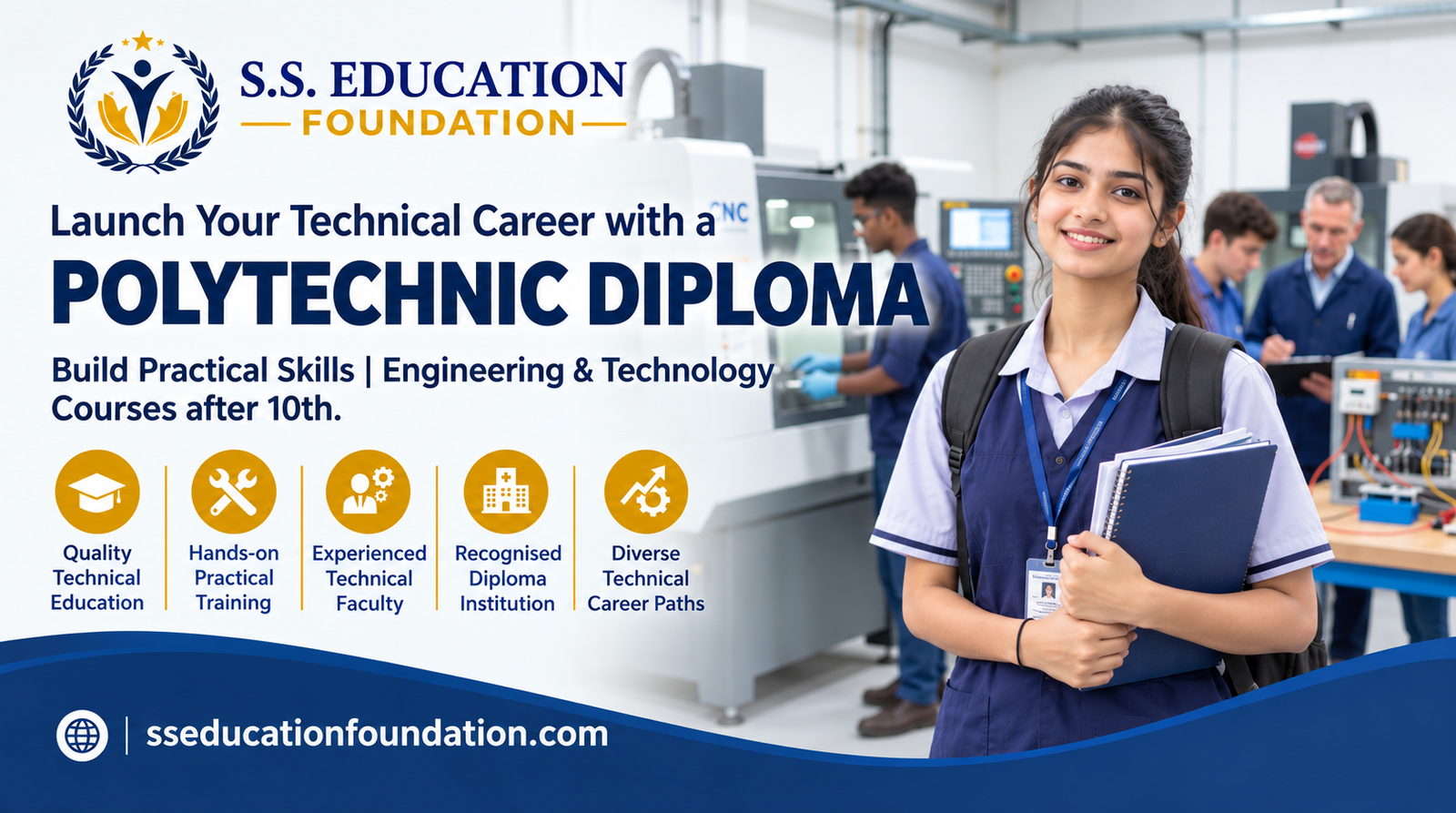
Choosing the right career path after Class 10th is one of the most critical decisions in a student’s academic journey. While many students opt for traditional higher secondary education (11th and 12th), technical diploma courses offer a direct and practical entryway into professional technical roles. SS Education Foundation Programs among these technical streams, enrolling in Polytechnic Courses After 10th has emerged as one of the most popular and job-oriented technical pathways in India.
In this detailed guide, we will cover everything you need to know about Polytechnic Courses After 10th, including eligibility criteria, admission procedures, popular course streams, higher education opportunities, and potential career options.
What are Polytechnic Courses?
Unlike regular degree programs that take three to four years, a diploma obtained through Polytechnic Courses After 10th usually spans three years.
These programs focus heavily on hands-on practical skills, workshop training, and real-world industrial exposure. As a result, students who complete Polytechnic Courses After 10th become job-ready at an early age and can directly start working or transition into advanced technical degree programs.
Why Choose Polytechnic Courses After 10th?
Choosing to pursue Polytechnic Courses After 10th offers several benefits for students aiming for an early start in technical industries:
- Early Career Start: Students gain practical technical skills and entry-level professional qualifications right after Class 10th.
- Cost-Effective Education: Polytechnic diploma programs are generally more affordable than full-time four-year B.Tech or B.E. degree programs.
- Direct Entry into B.Tech (Lateral Entry): Diploma holders can secure direct admission into the second year (3rd semester) of B.Tech programs through lateral entry schemes.
- Practical Industry Exposure: The curriculum focuses on laboratory experiments, workshops, and vocational training tailored to industry demands.
- Government Job Opportunities: Government sectors like Railways, SSC, State Electricity Boards, and Public Sector Undertakings (PSUs) frequently.
- Educational Qualification: Candidates must have passed Class 10th (SSLC/Matriculation) from a recognized state board, CBSE, or ICSE.
- Minimum Marks Required: Most institutes require an aggregate score of at least 35% to 50% in Class 10th board exams.
- Age Limit: Generally, candidates must be at least 14 years old at the time of admission.
Admission Process for Polytechnic Courses
The admission procedure for diploma programs usually follows state-level guidelines. Here are the primary ways to secure admission:
- Entrance Examination: Most states conduct polytechnic entrance exams (e.g., JEECUP in UP, Delhi CET, AP POLYCET, TS POLYCET) to evaluate students’ knowledge in Mathematics, Physics, and Chemistry.
- Merit-Based Admission: Some private institutes and state boards admit students directly based on their Class 10th board examination scores.
Popular Streams in Polytechnic Education
There are numerous specializations available depending on student interest and industry trends:
- Mechanical Engineering: Focuses on machine design, manufacturing process, automotive engineering, and thermodynamics.
- Civil Engineering: Covers construction management, structural design, surveying, and infrastructure development.
- Computer Science & Engineering: Covers programming languages, software development, database management, and computer networks.
- Electrical Engineering: Deals with power systems, electrical machines, circuits, and renewable energy technologies.
- Electronics & Communication Engineering: Covers embedded systems, microprocessors, telecommunications, and circuit design.
- Information Technology: Focuses on web development, system administration, and network administration.
Career Options and Job Opportunities After Polytechnic
1. Private Sector Jobs
Top manufacturing, IT, construction, and core engineering companies recruit diploma holders for roles such as:
- Site Engineer
- Junior Mechanical Engineer
- CAD Designer / Draftsman
- Network Technician
- Quality Control Assistant
2. Government Sector Opportunities
Diploma holders can apply for prestigious government positions through competitive examinations:
- Indian Railways (RRB JE): Junior Engineer roles in various technical departments.
- Staff Selection Commission (SSC JE): Technical posts in Central Water Commission, CPWD, etc.
- State Electricity Boards: Assistant Engineer/Junior Engineer positions.
- PSU Recruitment: Companies like BHEL, ONGC, NTPC, and IOCL regularly hire diploma trainees.
3. Higher Education Options
If students wish to expand their academic qualifications, they can pursue:
- B.Tech / B.E. via Lateral Entry: Direct admission into the 2nd year of undergraduate engineering degree programs.
To enroll in a Digital Marketing diploma after 10th, students must have passed Class 10th (Matriculation) from a recognized board (CBSE, ICSE, or State Board) with a minimum aggregate score of 35% to 50%. Basic computer knowledge and good communication skills are added advantages.
The polytechnic courses list after 10th features both technical and non-technical branches:
Civil Engineering
Mechanical Engineering
Computer Engineering
Electrical Engineering
Electronics & Communication
Automobile Engineering
Interior Design & Fashion Design
The best polytechnic courses after 10th depend on current market demand and student interest. Currently, top choices include Computer Science & Engineering (due to IT growth), Electrical Engineering, Civil Engineering, and Mechanical Engineering due to high demand in both government and core private sectors.
As mentioned, a polytechnic course after 10th is an industry-oriented diploma credential that trains students in practical technical skills, enabling them to work as technicians or junior engineers or take lateral entry into 2nd-year B.Tech programs.
Diploma in Mechanical Engineering
Diploma in Civil Engineering
Diploma in Computer Science & Engineering
Diploma in Electrical Engineering
Diploma in Electronics & Communication Engineering
Diploma in Information Technology
Diploma in Chemical Engineering
Conclusion
Opting for Polytechnic Courses After 10th is an excellent choice for students looking to gain practical skill sets, enter the job market quickly, or secure direct admission into B.Tech degree programs.