
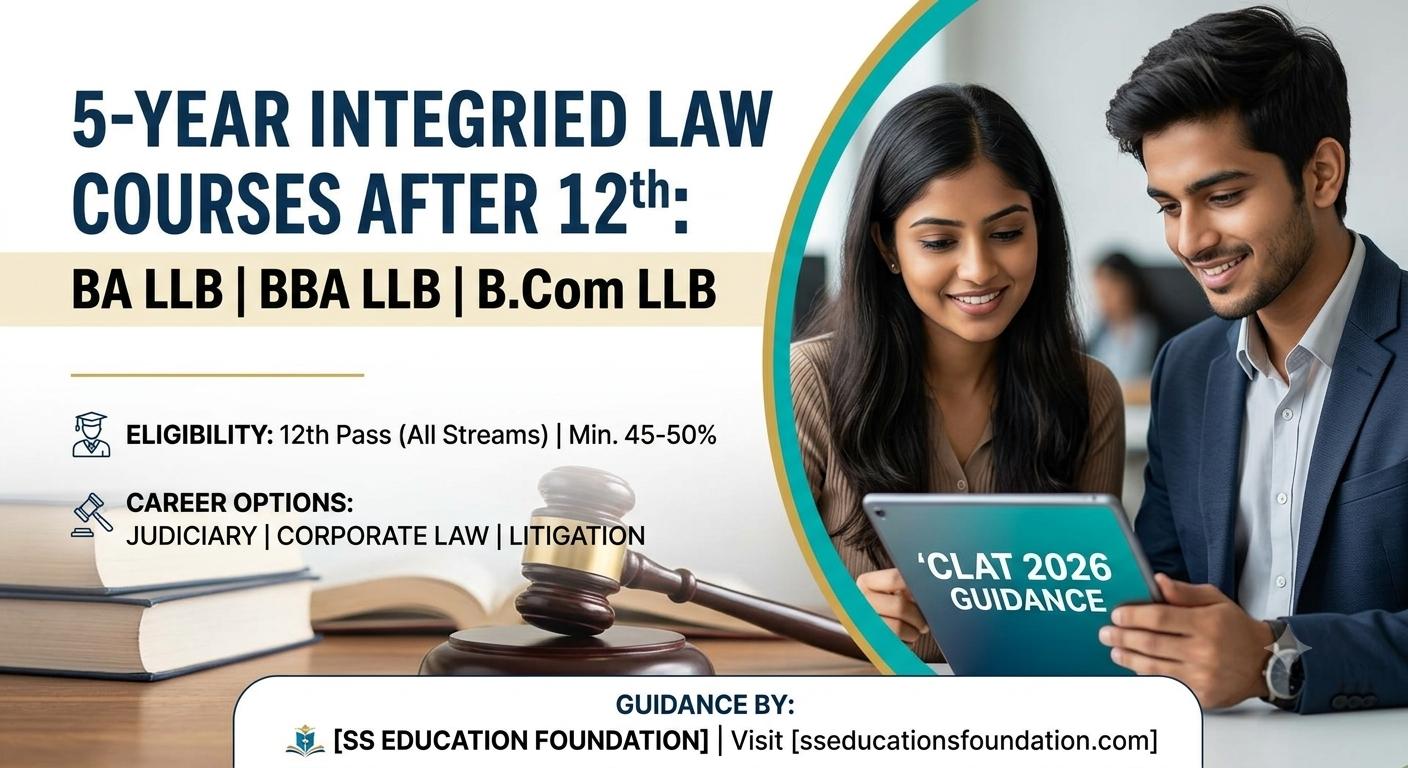
Building a career in the legal field after completing 12th grade is one of the most popular and high-paying career options today. Whether you aim to excel in legal studies, the justice system, corporate compliance, or judicial services, choosing the right law course after 12th is your crucial first step.
In this comprehensive guide, SS Education Foundation—a leading education foundation in India—provides expert guidance and admission assistance to help you explore the best law courses available after 12th, along with their eligibility criteria, entrance exams, and top career opportunities.
1. Best Integrated Law Courses After 12th (5-Year Programs)
After passing 12th, you can enroll directly into 5-year integrated law programs. These dual-degree programs allow you to complete your graduation (in Arts, Commerce, or Science) along with a Bachelor of Laws (LLB) degree simultaneously.
A. BA LLB (Bachelor of Arts + Bachelor of Laws)
- Duration: 5 Years
- Eligible Streams: Open to students from Arts, Commerce, or Science streams.
- Key Subjects: Political Science, Sociology, History, Constitutional Law, Criminal Law, Family Law.
- Best For: Students aspiring for Judicial Services (Civil Judge), Civil Services, Litigation, or Legal Consultancy.
B. BBA LLB (Bachelor of Business Administration + Bachelor of Laws)
- Duration: 5 Years
- Eligible Streams: Open to all streams (ideal for students inclined toward business and management).
- Key Subjects: Business Management, Corporate Law, Financial Management, Taxation Law, Contract Law.
- Best For: Careers in corporate law firms, MNCs, business legal advisory, and startup compliance management.
C. B.Com LLB (Bachelor of Commerce + Bachelor of Laws)
- Duration: 5 Years
- Eligible Streams: Ideal for Commerce stream students.
- Key Subjects: Accounting, Economics, Business Statistics, Banking Law, Taxation.
- Best For: Banking & finance sectors, tax consultancy, and corporate litigation.
D. B.Sc LLB (Bachelor of Science + Bachelor of Laws)
- Duration: 5 Years
- Eligible Streams: Science Stream (PCM / PCB).
- Key Subjects: Forensic Science, Environmental Law, Cyber Law, Intellectual Property Rights (IPR).
- Best For: Patent attorneys, cyber law experts, biotech & tech policy legal advisors.
2. Diploma & Certificate Law Courses After 12th
If you wish to build specialized skills through short-term programs, you can opt for the following diploma options:
| Course Name | Duration | Key Focus Area |
| Diploma in Cyber Law | 6 Months – 1 Year | Data Protection, Cybercrime & IT Act |
| Diploma in Intellectual Property Rights (IPR) | 1 Year | Patents, Trademarks & Copyrights |
| Diploma in Human Rights | 1 – 2 Years | Social Justice, NGO & Legal Aid |
| Diploma in Corporate Law | 1 Year | Business Compliance & Contracts |
3. Eligibility Criteria for Law Courses After 12th
According to SS Education Foundation, candidates applying for 5-year integrated law courses must fulfill the following criteria:
- Educational Qualification: Must have passed 10+2 (12th Grade) from a recognized board (CBSE, ICSE, UP Board, or State Boards).
- Minimum Marks Required:
- General / OBC Category: Minimum 45% – 50% aggregate marks.
- SC / ST Category: Minimum 40% – 45% aggregate marks.
- Age Limit: As per current Bar Council of India (BCI) regulations, there is no strict upper age limit for integrated law programs.
(Note: Can you pursue a 3-Year LLB directly after 12th? No, a 3-Year LLB program requires a completed Bachelor’s Degree in any discipline).
4. Popular Law Entrance Exams in India
To secure admission to top law colleges and National Law Universities (NLUs) in India, students must qualify for entrance examinations:
- CLAT (Common Law Admission Test): The primary national-level exam for admission to 22+ National Law Universities (NLUs).
- AILET (All India Law Entrance Test): Dedicated entrance exam for NLU Delhi.
- SLAT (Symbiosis Law Admission Test): Conducted for Symbiosis Law Schools.
- MH CET Law: State-level exam for top government and private law institutes in Maharashtra.
- LSAT India / State CETs: Accepted by various private universities and state institutions.
5. High-Paying Career Options After a Law Degree
Completing a law degree opens up lucrative career avenues in both public and private sectors:
- Advocate / Litigation: Practice in District Courts, High Courts, or the Supreme Court of India (following Bar Council enrollment).
- Judicial Services (Civil Judge): Clear State Judicial Services Examination to become a Magistrate / Civil Judge.
- Corporate Lawyer: Work as a legal counsel or corporate advisor in law firms, MNCs, and corporate enterprises.
- Public Prosecutor / APO: Apply for government legal roles as Assistant Prosecution Officers.
- Legal Analyst & Consultant: Advise banks, financial institutions, and consultancies on risk management and regulatory compliance.
- Cyber & Patent Specialist: Manage data security, intellectual property, and tech compliance for IT firms and startups.
6. Summary: Which Course Should You Choose?
- Judiciary / Civil Services Aspirants: 👉 Choose BA LLB
- Corporate Law & Business Management Interest: 👉 Choose BBA LLB or B.Com LLB
- Technology, IP Rights & Cyber Law Interest: 👉 Choose B.Sc LLB
Frequently Asked Questions (FAQs)
Q1. Can a Science or Commerce student pursue a BA LLB after 12th?
Ans: Yes. Students from any stream (Science, Commerce, or Arts) are fully eligible to apply for BA LLB integrated courses.
Q2. What is the average fee for a 5-year integrated law course?
Ans: The tuition fees range from ₹50,000 to ₹2 Lakhs in government institutes and from ₹5 Lakhs to ₹15 Lakhs in private universities and NLUs, depending on ranking and infrastructure.
Q3. Is registration with the Bar Council mandatory after completing a law degree?
Ans: Yes, to practice as an advocate in courtrooms, enrolling with the Bar Council of India (BCI) and qualifying for the All India Bar Examination (AIBE) is mandatory.
Get Expert Guidance & Admission Support:
For personalized college selection and expert career advice, connect with SS Education Foundation today and steer your legal career in the right direction!