
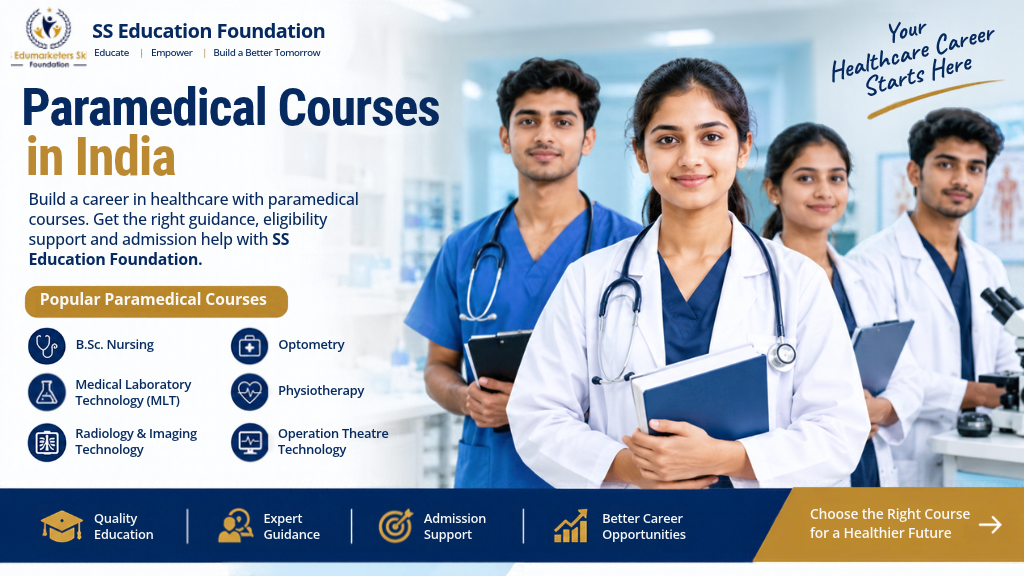
A career in the healthcare sector may not necessarily be confined to the jobs of a doctor or a nurse. Indian Paramedical Courses in India, are meant for such specializations wherein one gets trained to be a skilled lab technician, x-ray technician, surgical assistant, or an emergency ward attendant. Paramedics work in tandem with doctors, nurses, and surgeons to help them in analyzing or treating a patient in accordance with standard procedures.
Those students who are appearing or have appeared for their 10th or 12th-grade exams must look for information pertaining to the best health science courses. One must be aware of the eligibility criteria, syllabus, internships, accreditation, and career scope in order to choose the right course as per one’s preference and budget. With the right suggestions, there is a possibility of finding credible institutions for their desired paramedical course.
SS Education Foundation aims to provide you edifying information about education and career. We can help you understand the differences between the educational programs and guide you through the application procedure. This article will suggest the best paramedical courses and highlight the relevant facts one must consider before applying.
What Are Paramedical Courses?
A Paramedical and allied health care programs are for students who want to pursue technical careers or be part of the supporting healthcare cadre. Students are trained in various cadres such as laboratory, radiography, theatre assistant, and rehabilitation technology depending on the stream one chooses to specialize.
Paramedics and allied health care providers operate under the supervision of doctors, nurses, and other authorized personnel depending on the cadre. A professional’s permitted duties depend on their training, education, legal restrictions, work environment, and other factors. The National Commission for Allied and Healthcare Professions (NCAHP) regulates certain allied and healthcare professions under the National Commission for Allied and Healthcare Professions Act, 2021.. Therefore, students should consult their professional bodies to reveal the criteria for every line of work since not all allied healthcare programs are the same.
Popular Paramedical Courses in India
The right specialisation depends on the type of work you enjoy. For example, students can specialize in laboratory technology, radiography, operation theatre assistance, or rehabilitation technology, depending on their chosen field.
Here are some commonly considered options.
1. Medical Laboratory Technology
Medical Laboratory Technology focuses on laboratory procedures used to support the diagnosis and monitoring of diseases. Students learn about specimens, laboratory equipment, testing methods, quality control, and laboratory safety.
Common course names include:
- Diploma in Medical Laboratory Technology (DMLT)
- Bachelor of Medical Laboratory Technology (BMLT)
This field may suit students who enjoy biology, laboratory work, accuracy, and scientific procedures.
2. Medical Radiology and Imaging Technology
This specialisation helps students understand medical equipment and learn how diagnostic machinery works. Furthermore, students develop skills in patient positioning, image quality, radiation protection, and diagnostic methods based on their chosen course.
These programmes include diploma courses and bachelor’s degrees in Medical Radiology and Imaging Technology. However, the subjects may vary depending on the institution’s curriculum and eligibility criteria.
3. Operation Theatre Technology
Operation theatre technology prepares future professionals to work alongside the surgical team and ensure the operation room is in suitable condition for a surgery. Additionally, these programmes teach students about surgical equipment, medical instruments, infection control procedures, and patient safety.
This specialisation is perfect for those that can work accurately and calmly under the pressure of a busy hospital environment and strictly follow the rules of infection control.
4. Anaesthesia Technology
Anaesthesia technology is similar to operation theatre technology, but even more focused on the equipment used to give patients anaesthesia, and maintain their vital functions during a surgery. Students take classes on the instruments used by anaesthesia nurses and receive instructions in the correct preparation of the operating room and equipment.
As such programmes are mostly clinical, it is important to consider this factor when deciding to choose the specialisation, and make sure that the course gives enough practical experience for a successful career.
5. Physiotherapy and Rehabilitation
Physiotherapy focuses on the restorative functions of movement and the methods of rehabilitation. One of the most common degrees is the Bachelor of Physiotherapy (BPT), which requires a separate set of qualifications.
However, Physiotherapy programmes may differ in duration and professional recognition. Therefore, students should check the eligibility requirements before enrolling.
6. Optometry and Vision Care
This specialisation covers the basics of eye testing, optical devices, and the methods of testing vision.Additionally, students interested in eye care can pursue diploma or degree courses in Optometry.
However, Optometry and Ophthalmic Assistant programmes require different skills and qualifications. Therefore, students should check the exact course title before enrolling to avoid confusion.
Course Comparison: Duration, Eligibility and Career Paths
The following table provides an initial comparison to help you shortlist options. It is not a definitive admission notice: eligibility, duration, internship requirements, and professional recognition must be confirmed for the exact programme and institution.
| Course or specialisation | Typical study route | General eligibility direction | Potential work settings |
| Medical Laboratory Technology | Diploma or bachelor’s degree | Class 12 science is commonly relevant; check the specific course rules | Diagnostic laboratories, hospitals |
| Radiology and Imaging Technology | Diploma or bachelor’s degree | Science subjects may be required, depending on the programme | Imaging departments, hospitals |
| Operation Theatre Technology | Diploma or bachelor’s degree | Class 12 science is commonly relevant | Operation theatres, surgical centres |
| Anaesthesia Technology | Diploma or bachelor’s degree | Usually a science-oriented pathway; verify eligibility | Hospitals, surgical departments |
| Physiotherapy | Bachelor’s degree or other approved pathway | Course-specific academic and admission requirements | Rehabilitation centres, hospitals, clinics |
| Optometry | Diploma or bachelor’s degree | Requirements vary by qualification | Eye-care centres, optical and vision-care settings |
| Emergency Care | Course options vary by level and title | Confirm the required school subjects and training | Emergency services and healthcare facilities |
Important: The term “paramedical course” covers different qualifications. A short certificate, a diploma, and a professional bachelor’s degree should not be treated as interchangeable. The qualification’s recognition and permitted professional responsibilities matter as much as its duration.
Eligibility for Paramedical Courses in India After Class 10 or 12
Many students prefer courses that offer direct admission. However, eligibility requirements vary depending on the programme and its level of study..
After Completing Class 10
Some institutions provide an introductory healthcare or technical healthcare course after completing class 10. However, these programs do not allow one to practice all spheres of technical healthcare.
Therefore,
Prior to enrollment, it is essential to make sure that the program one selects is authorized for a specific field and has specialization, which one can gain after completing the course.
After Completing Class 12
Additionally, science students can choose from a wide range of technical and degree-level healthcare courses after Class 12.
These courses generally require good grades in the biology subject, however, eligibility criteria depend on the qualifications and affiliations of a specific organization.
Moreover,
some courses require one to appear for an entrance examination, gain qualifying marks, go through counselling, medical tests and clinical internship.
For graduates
Graduates may decide to pursue related post-graduate programmes, specializing qualifications or new undergraduate pathway. But, completing an irrelevant degree is not guaranteed entry to every post-graduate healthcare programme
Practical advice: before paying any application fee ask for the current prospectus with the exact qualification title, subject requirements, minimum marks, programme length and admissions procedure.
How to Choose the Best Paramedical Colleges in India
Searching for the best paramedical colleges in India can produce long lists of institutions. However, a college’s advertising, location, or low fee does not prove that its qualification is suitable for your career.
Use the following checklist to compare colleges before applying.
1. Verify the institution and course
Check the institution’s current legal status, the awarding university or body, and the applicable approval or recognition requirements for the specific course. Recognition of one programme does not necessarily mean every programme offered by the same institution is recognised.
For courses covered by the NCAHP framework, review the latest official notices, curriculum requirements, and applicable state-level requirements. You can begin with the official NCAHP information portal.
2. Check practical training facilities
Healthcare education needs more than classroom teaching. Ask whether the programme includes suitable laboratory sessions, equipment demonstrations, clinical exposure, and supervised practical training.
If an internship is required, find out where it takes place, how it is assessed, and whether it forms part of the stated course duration.
3. Compare the complete cost
Do not compare institutions using tuition fees alone. Request a written breakdown of:
- Admission and registration charges
- Tuition fees for the full programme
- Examination and practical fees
- Laboratory, uniform, or equipment charges
- Internship-related and other applicable costs
- Hostel and transport expenses, if needed
This helps families understand the actual financial commitment before admission.
4. Ask about career support
Ask the institution what career services it offers and whether it can provide clear information about previous graduates’ career pathways. Distinguish between general placement assistance and a confirmed employment offer.
No college can responsibly guarantee a job merely because a student completes a course.
5. Read the admission documents carefully
Check the course name, awarding body, fee-refund rules, attendance requirements, internship conditions, and examination arrangements. Keep copies of receipts and official communication.
These checks are especially important when an advertisement promises unusually low fees or immediate admission without explaining the qualification’s recognition.
Paramedical Courses in Delhi: What Should Students Check?
Paramedical Courses in India
Delhi boasts of having diverse educational institutes, apart from the healthcare facilities. It is as prudent as it needs to be in finding out a paramedical institute in the city. Narrow down on a couple of institutes which provide you with your preferred specialisation. Compare the eligibility criteria, training facilities, total fees, and the reputation of the qualification that the particular institute provides. You might end up naming institutes like Delhi Paramedical & Management Institute and Delhi Institute of Technology and Paramedical Sciences, using these names to start off your research rather than assuming that a specific course is approved or fit for you. Cross-verify the current name of the institution, campus, awarding body, course-specific requirements, and certification before you apply.
A useful comparison sheet could look like this:
| What to compare | College A | College B |
| Exact course and qualification | Confirm directly | Confirm directly |
| Awarding university or body | Verify independently | Verify independently |
| Admission eligibility | Obtain prospectus | Obtain prospectus |
| Practical and clinical training | Ask for details | Ask for details |
| Total course cost | Request written fee sheet | Request written fee sheet |
| Internship and career support | Confirm terms | Confirm terms |
The best choice is the institution that meets your educational and professional requirements—not necessarily the one with the most attractive advertisement.
How SS Education Foundation Can Help You Explore Courses: Paramedical Courses in India
Students sometimes know they want a healthcare career but are unsure which programme suits their academic background or budget. This is where structured course research and admission guidance can help.
SS Education Foundation provides information and guidance relating to educational programmes, institution selection, admission procedures, documentation, and career pathways. Students can explore the foundation’s existing paramedical programme page to review listed options, including laboratory technology, radiology, operation theatre technology, and other related programmes.
You can also review the foundation’s education support services to understand its general approach to course guidance, scholarship information, and applicable financial-support opportunities.
If affordability is a concern, ask about the terms and eligibility requirements for any relevant support. Financial assistance depends on the applicable programme, institution, availability, and conditions; it should not be assumed before written confirmation.
For additional help, visit the SS Education Foundation website and use its contact options to enquire about your preferred course.
Career Opportunities After a Paramedical Courses in India Qualification
Career options depend on the course you complete, the recognition of your qualification, your practical skills, and the applicable professional requirements.
Potential work settings include:
- Diagnostic and medical laboratories
- Hospital imaging departments
- Operation theatres and surgical units
- Rehabilitation and physiotherapy facilities
- Eye-care and vision-care centres
- Emergency and other relevant healthcare services
Some graduates may pursue further study or specialise in a related area. Others may seek entry-level technical roles after meeting the relevant requirements.
Before choosing a course, ask yourself three questions:
- Do I prefer laboratory work, equipment-based tasks, rehabilitation, or direct patient support?
- Does the qualification match the role I want to pursue?
- Can I meet the academic, practical, and financial requirements of the programme?
Your answers can help narrow your choices and make conversations with admissions teams more productive.
Frequently Asked Questions
1. Which paramedical course is best after Class 12?
There is no single best course for every student. Medical Laboratory Technology, Radiology and Imaging Technology, Operation Theatre Technology, Physiotherapy, and Optometry serve different interests and career paths. Compare eligibility, course recognition, practical training, and career requirements before deciding.
2. Can I study paramedical courses after Class 10?
Some vocational or introductory healthcare programmes may accept students after Class 10. However, many diploma and degree programmes have specific Class 12 requirements. Check the exact eligibility criteria before applying.
3. How long do paramedical courses take?
Duration varies by qualification, specialisation, and curriculum. Diplomas and bachelor’s degrees may have different academic and internship requirements. Always use the current official prospectus for the programme you intend to join.
4. How do I find a recognised paramedical institute in Delhi?
Identify the exact course and awarding body first. Then verify the institution’s current status and applicable recognition requirements through the relevant official authority or university. Also inspect the practical training arrangements and written fee structure.
5. Are paramedical courses available with financial assistance?
Some students may be eligible for scholarships, fee support, or other education assistance, depending on the programme’s conditions. Contact the relevant organisation or institution and obtain written confirmation of eligibility, covered costs, and application deadlines.
6. Does completing a paramedical course guarantee a job?
No. Employment depends on the qualification, applicable registration or other professional requirements, skills, vacancies, employer criteria, and experience. A course can prepare students for relevant opportunities, but it cannot guarantee employment.
Conclusion: Choose Your Healthcare Course Carefully
Choosing among paramedical courses in India is an important decision because it affects your education, finances, and future career options. Start with your interests and academic qualifications, compare suitable specialisations, and verify the institution and course before paying fees.
For students considering paramedical courses in Delhi or elsewhere in India, careful research can help avoid unsuitable programmes and misleading admission claims. Practical training, recognised qualifications, transparent costs, and clear career pathways should guide your final decision.
SS Education Foundation aims to help students explore education programmes and make informed decisions about their next steps. Visit the foundation’s paramedical programme page or contact its team for course-related information and guidance. Confirm the specific course, eligibility, fees, and any applicable support before proceeding with admission.